
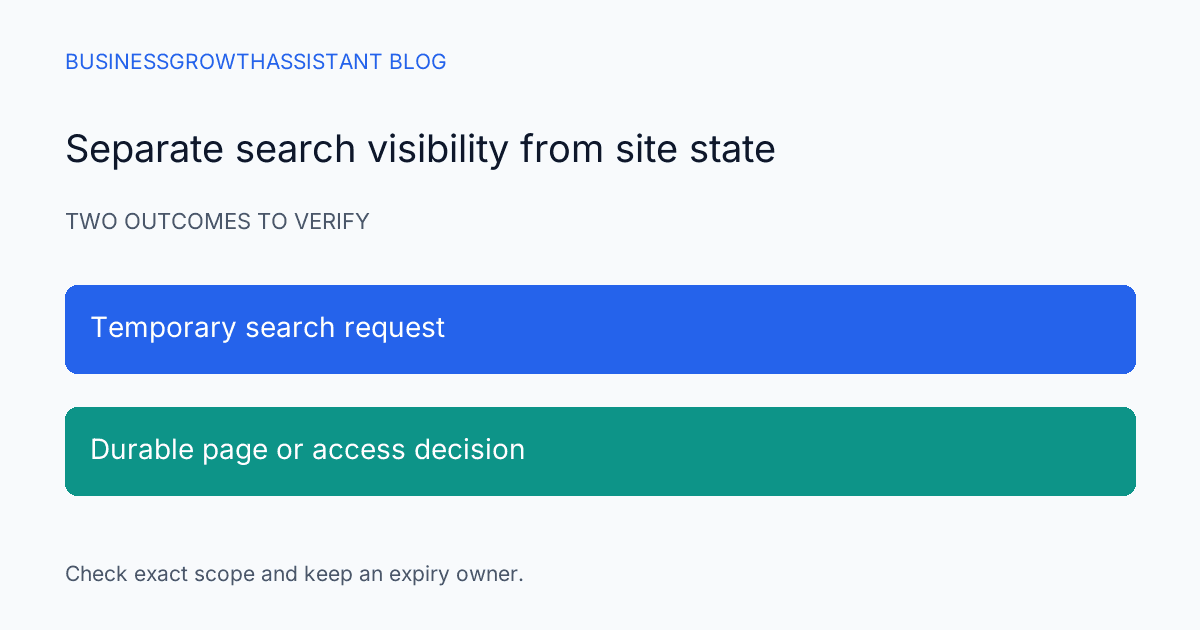
A request to take a page out of search sounds simple until the operator must decide which URL, which variants, and for how long. A temporary block can be useful for an urgent search-visibility problem, but it does not replace the decision about what should happen to the content on the website.
For a marketing assistant, the first job is to turn the request into a precise, reviewable instruction. The team should know whether it wants to hide a search result temporarily, change an outdated snippet, remove content permanently, or move a page. Those objectives require different work and should not be collapsed into one generic removal task.
State the desired end condition
Ask the content owner to describe what a visitor should experience at the URL and what should appear in search. The page might need to remain publicly accessible while its search appearance is addressed. Alternatively, the content itself may need to be removed or access restricted. A search-result change does not establish that the underlying page is private.
Write the reason and the owner of the decision in the work record. Use a reference to restricted material where needed rather than copying sensitive content into a broad task thread. The operator needs enough context to choose the correct scope, but a removal process should not create additional copies of material the business is trying to control.
Know the temporary tool's boundary
Google documents that a successful temporary removal lasts about six months and does not stop crawling. The tool can target a URL or a prefix, and its matching rules include important treatment of URL variants. Google also explains that permanent removal requires a separate supported change to the site; robots.txt is not the recommended removal mechanism. Search Console removal guidance
Those facts support a two-part work record: the temporary search action, if appropriate, and the durable content action. Do not close the second part merely because the first request was accepted. A temporary result can expire while the original content remains available.
Inventory the intended URLs
Start with the exact page named by the owner. Check whether the request concerns only that page, a group of related pages, or an entire directory. Identify relevant query-string variants and alternate hosts where the same content may be reachable. Record which variants are known to exist rather than inventing every conceivable URL.
For a hypothetical retired campaign page, the owner may intend to remove only one landing page while keeping the campaign archive. A broad prefix could reach more material than intended. Prepare examples that should match and examples that must remain unaffected. This makes the scope review concrete instead of asking someone to approve an abstract technical string.
Do not assume that a trailing slash, a similar filename, or a host variation has no effect. Read the current tool guidance for the chosen request type and compare it with the site's actual URLs. The appropriate scope depends on both the platform's matching rules and the website's route structure.
Separate removal from canonical cleanup
If the underlying problem is duplicate versions of the same content, first identify the desired canonical behavior. Hiding a URL in search does not, by itself, establish the preferred version or repair internal links. A removal request can therefore be the wrong instrument for a routine canonicalization issue.
Likewise, moving content calls for a migration decision about the old and new destinations. The assistant should route that work to the site's established content or engineering process. A temporary search block may hide a symptom while leaving visitors and internal links on an obsolete route.
The practical question is what defect the action fixes. If the answer is only that it makes an unwanted result disappear for a while, the work record should say so. It should also name the remaining site change needed to reach the owner's durable objective.
Prepare the request for the authorized operator
The review packet can be short: property, exact scope, intended matching examples, reason, desired duration, and permanent follow-up if one is needed. Include the expected effect and the pages that must remain available. The owner can then approve a specific action rather than a vague request to clean up search.
The operator should have the required authority in the correct Search Console property. Do not borrow credentials or switch to a different property because access is easier. If the assistant's role is limited to preparation, it can still complete the inventory and evidence so the authorized person has little ambiguity left to resolve.
Before submission, compare the proposed value with the approved scope one final time. A copied root URL or truncated path can have a much broader effect than the intended page. This is a short check with a large practical benefit, especially during an urgent cleanup.
Verify the request and the website separately
After an authorized submission, record the request type, scope, status, and time. An in-progress request is not a completed removal. Preserve the status evidence and follow the platform's supported review path rather than repeatedly submitting duplicates because the result is not immediate.
Then verify the underlying website action independently. If the owner required content removal, inspect the actual URL response and public accessibility. If the owner required a page to remain accessible, confirm that it still works. Search visibility and page availability are separate outcomes and need separate observations.
Do not use one personalized search as the only evidence of completion. Search results vary and absence in one query does not explain the request state. The platform status and the website response provide more specific evidence for the work that was actually authorized.
Keep an expiry owner
A temporary block needs a review date and a named owner. Set the reminder early enough to inspect the durable fix before the temporary period ends. The owner may decide the page should become eligible again, or may need to finish the underlying removal. Either choice should be intentional.
A SEO distribution assistant can maintain this record and collect the follow-up evidence. For problems involving duplicate destinations, the canonical-conflict research provides related context. The removal task is complete only when the exact authorized scope and the desired website state are verified, with any temporary expiry still owned.
Sources
- Google Search Console Help, Removals and SafeSearch reports tool, checked October 2, 2026.
