
Published September 6, 2026.
Research question
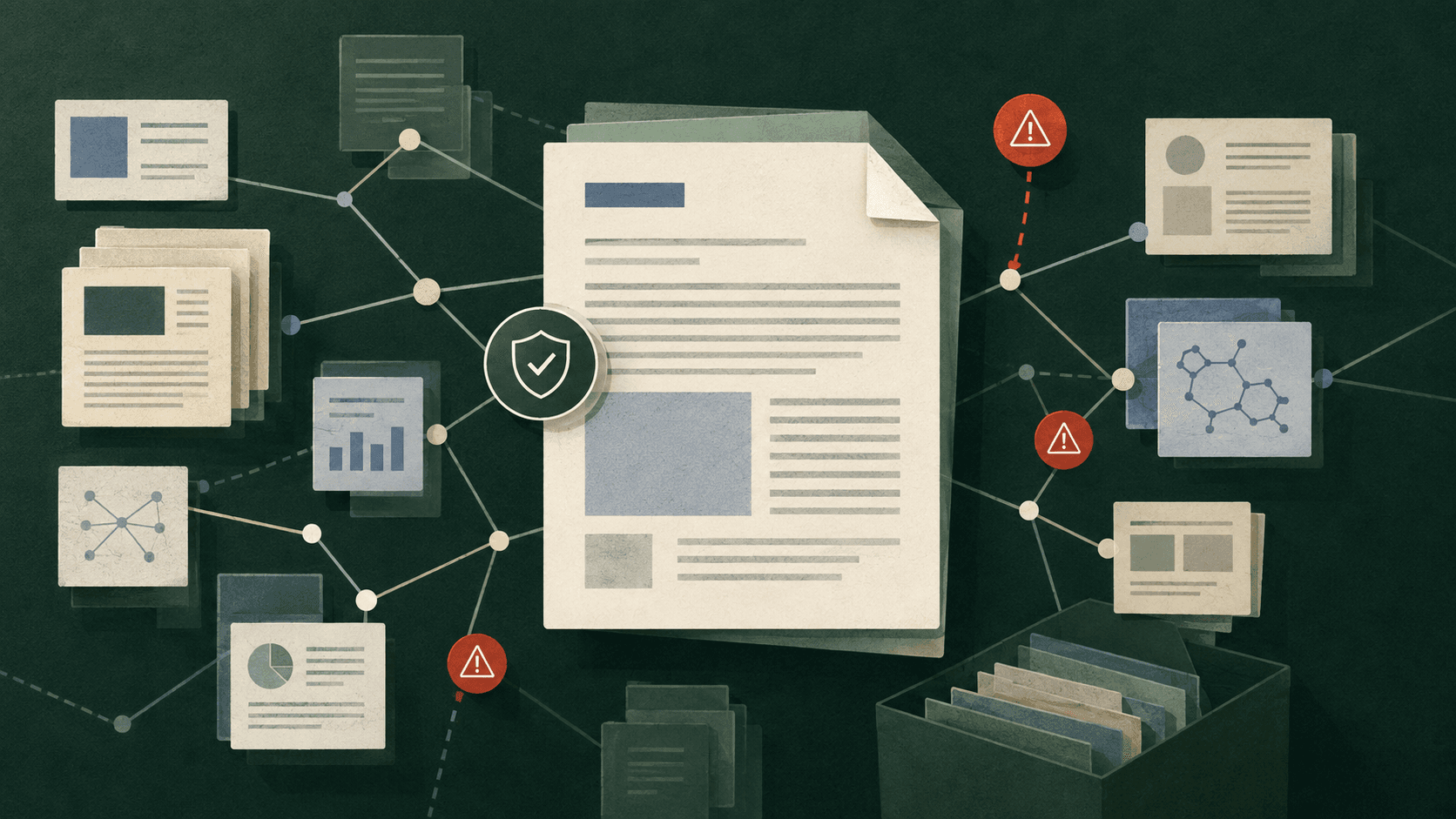
Which citations should a small editorial team recheck first? Treating every link equally wastes review capacity. Ignoring maintenance leaves operational articles attached to moved documentation, superseded reports, or definitions that no longer match the claim.
Scope and method
Score each material claim on four dimensions: source volatility, decision consequence, evidence fragility, and replacement difficulty. Volatility is high for prices, product interfaces, regulations, and frequently revised benchmarks. Consequence is high when a reader may spend money, change compliance behavior, or make a staffing decision. Evidence is fragile when the source lacks a stable identifier, method, date, or accessible archive.
Crossref's metadata services illustrate how persistent identifiers and structured bibliographic metadata can help locate scholarly works even when a publisher URL changes. The Library of Congress describes web archiving as preserving selected web content, demonstrating both the value and selectivity of archives. Google's people-first guidance emphasizes trustworthy presentation and clear sourcing. None of these sources guarantees that every cited webpage will remain available or that an archived page remains current advice.
Review tiers
Tier one contains volatile, high-consequence claims and should be checked before publication and on an event-driven watch. Tier two contains important benchmarks and product practices reviewed on a scheduled rotation. Tier three contains stable background sources that can be sampled less often. A broken link elevates technical urgency, but the editorial repair still depends on whether the source supports the claim.
For each review, preserve the claim, source, access date, relevant definition, population or version, and limitation. If a replacement changes the underlying metric, update the prose rather than swapping the URL silently. When no equivalent authority exists, narrow or remove the claim.
Operating application
BusinessGrowthAssistant can maintain the register, test access, and prepare replacement candidates. A subject owner approves changes to conclusions and high-consequence guidance. Archive links can preserve historical context, but they should not be presented as proof that outdated instructions remain applicable.
Limitations
Risk scores contain judgment and can drift between reviewers. Automated status checks do not detect semantic change, paywall changes, or revised methodology. Archives may be incomplete, restricted, or excluded by site owners. This framework prioritizes review; it cannot certify permanent truth or legal sufficiency.
Evidence-led conclusion
Citation maintenance becomes manageable when priority reflects both likelihood of change and cost of error. The defensible routine checks high-risk claims deeply, keeps a trace of replacements, and states when the evidence no longer supports the original wording.
Sources
- Crossref, REST API documentation: https://www.crossref.org/documentation/retrieve-metadata/rest-api/
- Library of Congress, Web Archiving: https://www.loc.gov/programs/web-archiving/about-this-program/
- Google Search Central, Creating helpful, reliable, people-first content: https://developers.google.com/search/docs/fundamentals/creating-helpful-content