Published September 7, 2026.
Research question
How can a small team make daily SEO work repeatable without using a checklist as a substitute for judgment?
Scope and method
This evidence brief translates general checklist and safety principles into content operations, then compares them with Google's introductory guidance on organizing and helping search engines understand a site. It is a practice framework, not an experimental measurement of ranking outcomes.
Findings
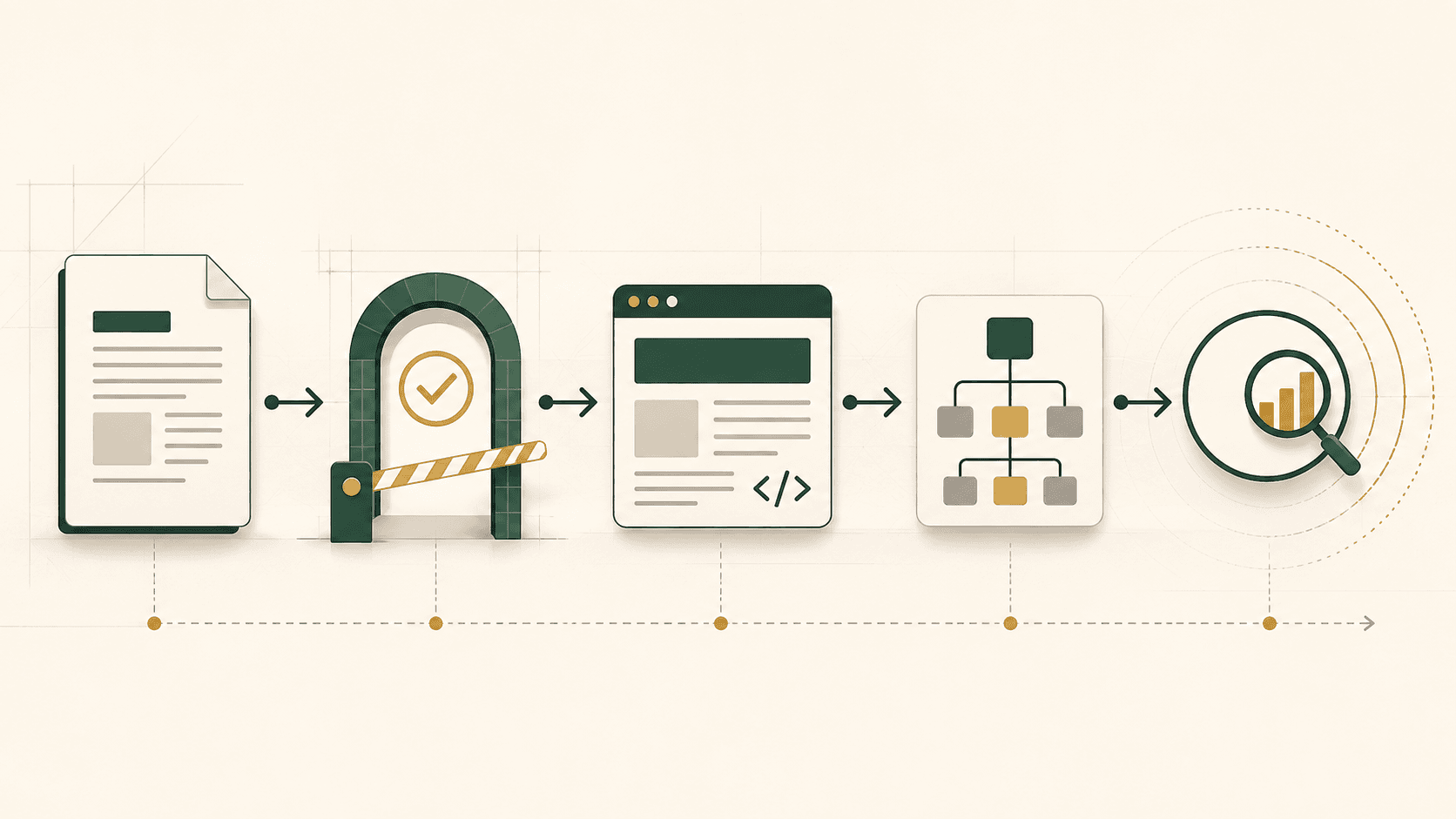
Routine checks are strongest when they cover observable failure points: route availability, canonical identity, dates, sitemap presence, images, and layout. They are weaker when they ask an operator to decide broad strategy with a checkbox. Separating mechanical verification from editorial judgment reduces context switching and makes escalation clearer.
A useful routine therefore has a fixed entry point, an expected artifact, a time box, and a stop condition. Exceptions should name the evidence, affected route, and decision owner. Completion means that the controlled checks passed, not that traffic or indexing was guaranteed.
Application
BusinessGrowthAssistant can use a morning scan for incidents, a publishing manifest for new work, and a separate weekly forum for topic overlap or strategic changes. This preserves a daily cadence while protecting decisions that need deeper review.
Limitations
The supporting checklist literature is broader than SEO and does not establish an ideal number or order of checks for this site. Google's documentation describes good practices, not guaranteed performance. Team experience, site architecture, and release volume will change the appropriate routine.
Conclusion
Daily routines should make common defects harder to miss and judgment calls easier to route. Their value is operational consistency, not proof of search impact.
Sources
- World Health Organization, Patient safety: https://www.who.int/teams/integrated-health-services/patient-safety
- Atul Gawande, The Checklist Manifesto, Metropolitan Books, 2009
- Google Search Central, SEO Starter Guide: https://developers.google.com/search/docs/fundamentals/seo-starter-guide