Monday's paid-ad report can make a stable campaign look expensive. Spend from last week is already visible, while some people who clicked have not yet completed the action being measured. Dividing the spend by the conversions available on Monday produces correct arithmetic for an unfinished observation period. It does not necessarily produce a fair comparison with a month-old cohort.
For a founder delegating advertising administration, the decision is whether a reported increase in cost per acquisition warrants a budget recommendation now. This research develops an observation schedule that distinguishes an early warning from a mature performance comparison. Its central recommendation is to compare cohorts at similar ages, retain the original snapshots, and give urgent operational failures their own escalation path.
Evidence and method
This is a documentary analysis of two Google Ads Help pages checked on October 2, 2026. One describes conversion-lag reporting; the other explains how to inspect time to conversion. They establish product behavior and a way to examine account history. They do not provide a universal waiting period for small businesses or evidence about BusinessGrowthAssistant customer performance.
The worked examples below are hypothetical arithmetic exercises. They hold spend and conversion definitions fixed to isolate observation timing. The proposed operating rules are our analysis, not settings prescribed by Google. They should be adapted to the business's conversion action, reporting volume, cash constraints, and authority for changing budgets. No advertising account was accessed or experimentally modified for this research.
What Google documents
Google explains that conversion lag is the time between an ad interaction and the conversion action. Recent performance can therefore appear weaker than older performance: the spend is present while later conversions are still absent. Its conversion-lag reporting provides forecasts for eligible campaign types, including Search and Performance Max. A forecast represents expected additional outcomes rather than completed acquisitions. Google Ads Help
Google also documents a Days to conversion segmentation. For examining historical delay, its instructions call for a reporting range ending at least 30 days earlier, or longer for a longer conversion window. Conversion estimates can also reflect adjustments, which makes an estimate different from a simple promise that today's count will only increase. Time-to-conversion guidance
The denominator problem in a weekly meeting
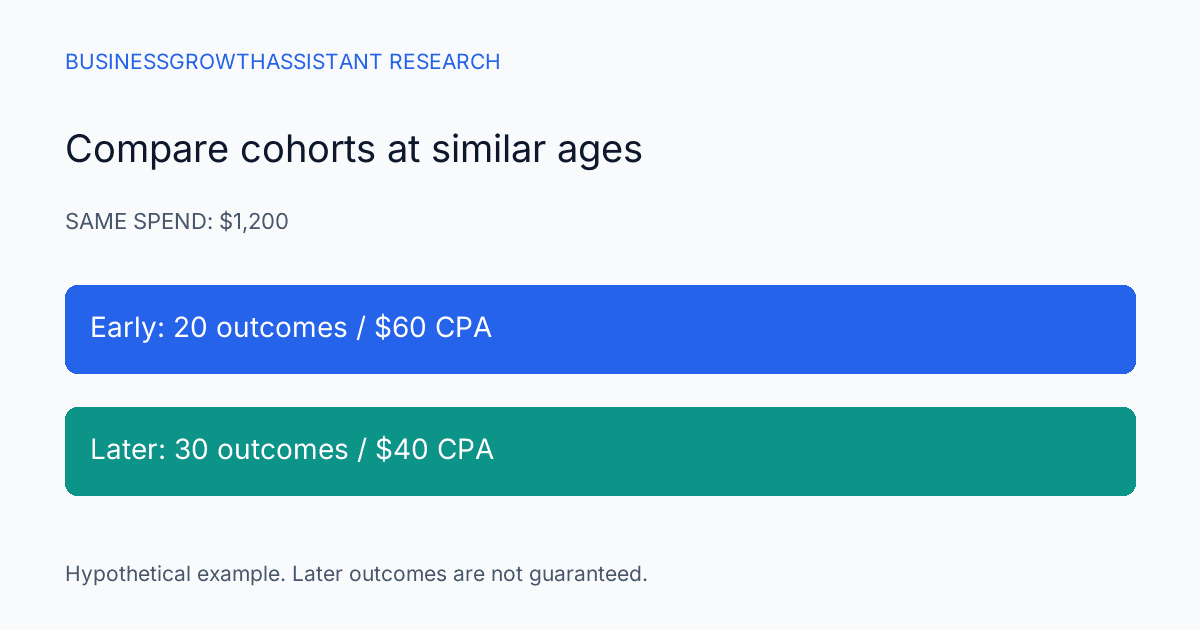
Imagine two hypothetical seven-day cohorts, each with $1,200 in spend. The older cohort has 30 recorded acquisitions, giving a CPA of $40. The newer cohort has 20 acquisitions at its first review, giving a CPA of $60. A report comparing those snapshots shows a 50 percent increase in acquisition cost. That calculation describes the available counts; it does not explain the difference.
Suppose another ten acquisitions are subsequently credited to the newer cohort. Its observed CPA becomes $40 without changing the original spend. A manager who treated the first comparison as settled might have reduced exposure before the people already acquired had finished converting. Conversely, if the newer cohort remains at 20, delay did not explain the gap. The initial report alone cannot tell these futures apart.
A useful report therefore preserves both statements: current observed CPA is $60, and the cohort has had less time to accumulate outcomes than the comparator. That is more actionable than suppressing the number or automatically dismissing it as lag. The budget owner can assess whether the unresolved difference matters enough to change a decision while more evidence arrives.
Build a maturity profile for the actual outcome
A team measuring consultation requests should not borrow the delay pattern of a campaign measuring paid subscriptions. Even within one account, different conversion actions may occur at different points in the buying process. Start by listing the actions included in the performance measure and deciding whether the manager actually wants inquiries, qualified opportunities, purchases, or a blended operational signal.
Next, inspect older cohorts where the relevant observation window has elapsed. Save the report range, extraction time, included actions, and breakdown of outcomes by delay. Review more than one cohort so a launch, holiday, tracking repair, or unusually large customer does not determine the entire policy. Where volume is low, describe the evidence as sparse rather than presenting an unstable percentile as a dependable cutoff.
The objective is a practical maturity label. For example, a team might designate its first weekly snapshot as provisional and require a later review before routine budget reallocations. The interval should come from its own observed distribution and tolerance for delayed decisions. Seven days, fourteen days, and thirty days are possible observation points, not general recommendations or assurances of completeness.
Keep snapshots that answer different questions
A simple working file can contain the cohort start and end, snapshot timestamp, spend, observed conversions, observed CPA, selected action set, and maturity note. Preserve the earliest value instead of overwriting it. A second snapshot then reveals how much the report changed after the meeting, which helps the team evaluate its own decision process.
Separate any platform estimate into an explicitly named column. Do not add estimated conversions to observed conversions and label the resulting total as actual customers. If a manager wants a scenario, show the calculation as a scenario: with five more outcomes, $1,200 divided by 25 would be $48. The expression explains sensitivity without asserting that the five outcomes will occur.
Also keep the reporting basis consistent. A CRM list of inquiries received during the week answers an operational arrival question. A campaign cohort organized around advertising interactions answers an acquisition question. A discrepancy between them should trigger reconciliation of dates, definitions, and attribution scope before it is described as missing leads. Neither system becomes the universal source of truth simply because its total is larger.
A budget decision with an explicit uncertainty boundary
Consider a hypothetical founder who must decide whether to move $300 of next week's allocation from Campaign A to Campaign B. Campaign A has the higher recent observed CPA, but its historical outcomes arrive more slowly. The assistant's job is to present comparable evidence and the unresolved exposure, not to manufacture a single adjusted ranking from an assumed average delay.
The comparison should include each campaign at a similar cohort age, the current provisional figures, and the number of outcomes underlying the calculation. If the mature comparison favors B and the provisional comparison agrees, the owner has a more coherent reason to consider reallocation. If they disagree, the conflict belongs in the decision note. A choice may still be necessary, but the rationale should acknowledge what is unknown.
Business constraints can justify acting before the data matures. A hard spending ceiling, an unavailable service, or a verified broken landing page requires timely attention. These conditions are different from interpreting an immature CPA. Keeping separate escalation rules prevents conversion lag from becoming an excuse to ignore an operational defect.
The delegated work boundary
An assistant can maintain the cohort file, check conversion definitions, collect the account's delay reports, and flag observations that cross a pre-agreed threshold. The owner should specify who may alter budgets, targets, or conversion settings. A request to prepare reporting should not silently become authority to change the optimization objective.
The handoff should also specify who resolves conflicting evidence. If CRM arrival counts rise while campaign-attributed outcomes fall, the reporting assistant may need a tracking specialist or sales operations owner to explain the join. A useful escalation includes the date ranges, affected action names, account report, CRM definition, and exact difference. It does not begin with a speculative claim that the platform lost data.
This work fits a paid ads operations role when the recurring need is disciplined reporting and administration. The related conversion-tracking verification research addresses whether the outcome is being captured correctly; the present question is when captured outcomes are mature enough to compare.
Limitations and a practical conclusion
Historical delay can change when the offer, audience, sales process, conversion definition, or campaign mix changes. A stable prior month is evidence for a review policy, not a guarantee for the next cohort. Low-volume campaigns may never support precise timing estimates, and later adjustments can complicate the idea of a permanently final number.
The most useful control for a lean team is modest: preserve when the number was observed and how old the cohort was. Report early performance as early performance, compare like-aged cohorts where possible, and keep forecasts separate from actual outcomes. This makes a weekly CPA useful without asking it to answer a question that the available conversions cannot yet settle.
Sources
- Google Ads Help, About conversion lag reporting, checked October 2, 2026.
- Google Ads Help, Find out how long it takes for your customers to convert, checked October 2, 2026.
Sources
- Google Ads Help, About conversion lag reporting, checked October 2, 2026: https://support.google.com/google-ads/answer/9347141?hl=en
- Google Ads Help, Find out how long it takes for your customers to convert, checked October 2, 2026: https://support.google.com/google-ads/answer/6239119?hl=en