Published August 27, 2026.
Research question
Can internal links help a small business site get new research articles discovered, and what can those links reasonably do? A daily article routine creates a practical problem. New pages need to be reachable by people and crawlers, but adding links everywhere can make older pages noisy and make the site's subject boundaries harder to understand. This review asks what an internal link contributes, what evidence supports its use, and where the claim should stop.
Evidence scope and method
The method reads Google's link guidance, SEO Starter Guide, and URL structure guidance as primary documentation. It separates three jobs: helping a reader move to a relevant next page, giving crawlers a crawlable path, and clarifying a page relationship through anchor text and surrounding context. It does not measure a specific site's crawl rate or claim that one link guarantees indexing. Those questions require site-specific logs and Search Console evidence.
What the evidence supports
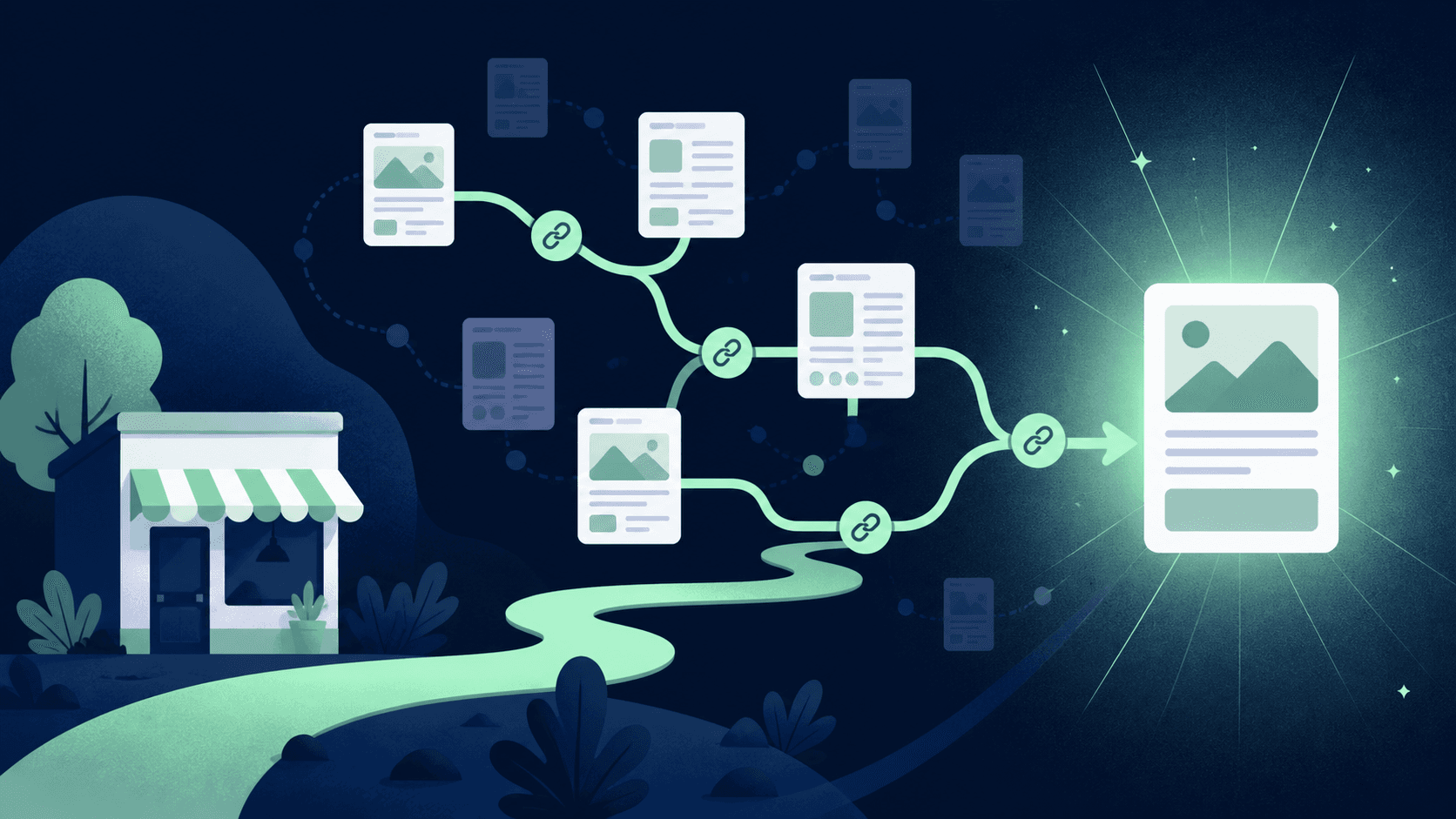
Google says links can help it find new pages and understand relevance. It also explains that a generally crawlable link is an anchor element with an href attribute. For a small site, that makes ordinary in-page links a dependable part of the discovery path. A research article linked from a relevant index, service page, or related article is easier for a reader to reach than an isolated file that appears only in an internal registry.
The link also carries context. Descriptive anchor text tells the reader what lies ahead and gives a crawler more information than a vague label such as "read more." The wording should describe the destination rather than repeat a keyword mechanically. If an article examines service-page refresh decisions, a link called "evidence for refreshing a service page" is clearer than a string of unrelated search terms.
The relationship matters more than raw link count. A link from a page that discusses daily content operations to a research article about internal linking has a natural reason to exist. A link from a page about a different service may be less useful unless it helps with a decision the same reader is making. Google's starter guidance treats optimization as a way to help search engines crawl, index, and understand content. Understanding includes knowing which pages belong together.
A small-site linking model
Start with the index. The Research index should expose each article through a normal route and a clear title. This is the broadest discovery layer and the easiest place for a person to browse. The sitemap is a separate technical aid. It should list canonical URLs, but it should not be treated as a replacement for useful navigation.
Then add links where the reader's question changes. An article can link to a service page when the research reaches an operational decision. A service page can link back to a research explanation when visitors need more detail before contacting the business. Related research pages can link to one another when they use different evidence to answer neighboring questions. The links should be added because the destination is useful at that moment.
Finally, inspect orphan risk. A newly published article should have at least one intentional path from a stable index or relevant page. The review should verify that the href is real, the route is canonical, and the destination is not a draft or a redirected identity. This is a simple operational check, but it keeps publishing and information architecture connected.
What internal links cannot prove
An internal link cannot prove that Google will index a page, rank it, or send qualified visitors. Crawl discovery is only one part of search. The page still needs a useful answer, accurate metadata, a stable route, and evidence appropriate to its question. A large number of links cannot compensate for thin or duplicated research.
A link also cannot turn unrelated pages into a coherent cluster. If an editor adds links only to distribute authority or create the appearance of breadth, the result can confuse readers. The site's niche should remain visible. BusinessGrowthAssistant focuses on daily routines for articles and SEO improvements, so the link network should help an operator move between research, service decisions, and operating guidance. It should not make every page point to every other page.
Review questions for an operator
For each proposed link, ask what question the reader has just asked, what the destination answers, and whether the anchor text describes that answer. Check the HTML path or rendered output rather than relying on a CMS label. Check that the destination is same-site when the purpose is internal discovery and that the canonical route matches the public route.
Also ask whether the link changes the page's claim. A link may narrow a statement by sending readers to the evidence, or broaden it by introducing a related topic. If the destination does not support the sentence around it, the link is decoration. Remove it or rewrite the surrounding explanation.
Limitations
The source guidance describes how links and URLs work in general. It does not provide a guaranteed link count, a universal site hierarchy, or a promised time to discovery. Search systems can change, and a site's results depend on factors outside this review. A small team should use internal links as one observable part of an editorial system and confirm outcomes through its own logs and search data.
Evidence-led conclusion
Internal links can help a small site make new research articles reachable and clarify how pages relate, especially when the links use normal href-based navigation and descriptive anchor text. They do not guarantee indexing, rankings, or conversions. The sound practice is to give every new article a relevant path from the Research index or an existing page, then add only the contextual links that help a reader make the next decision. Discovery improves when the architecture is useful first and technically crawlable as a consequence.
Sources
- Google Search Central, SEO link best practices: https://developers.google.com/search/docs/crawling-indexing/links-crawlable
- Google Search Central, SEO Starter Guide: https://developers.google.com/search/docs/fundamentals/seo-starter-guide
- Google Search Central, URL structure best practices: https://developers.google.com/search/docs/crawling-indexing/url-structure