Published September 6, 2026.
Research question
What can a lean team responsibly say about conversions associated with organic content? Search performance, site events, CRM outcomes, and consent choices describe different parts of a journey. Joining them can improve operations, but it can also create false precision when identifiers, windows, and definitions are unclear.
Scope and method
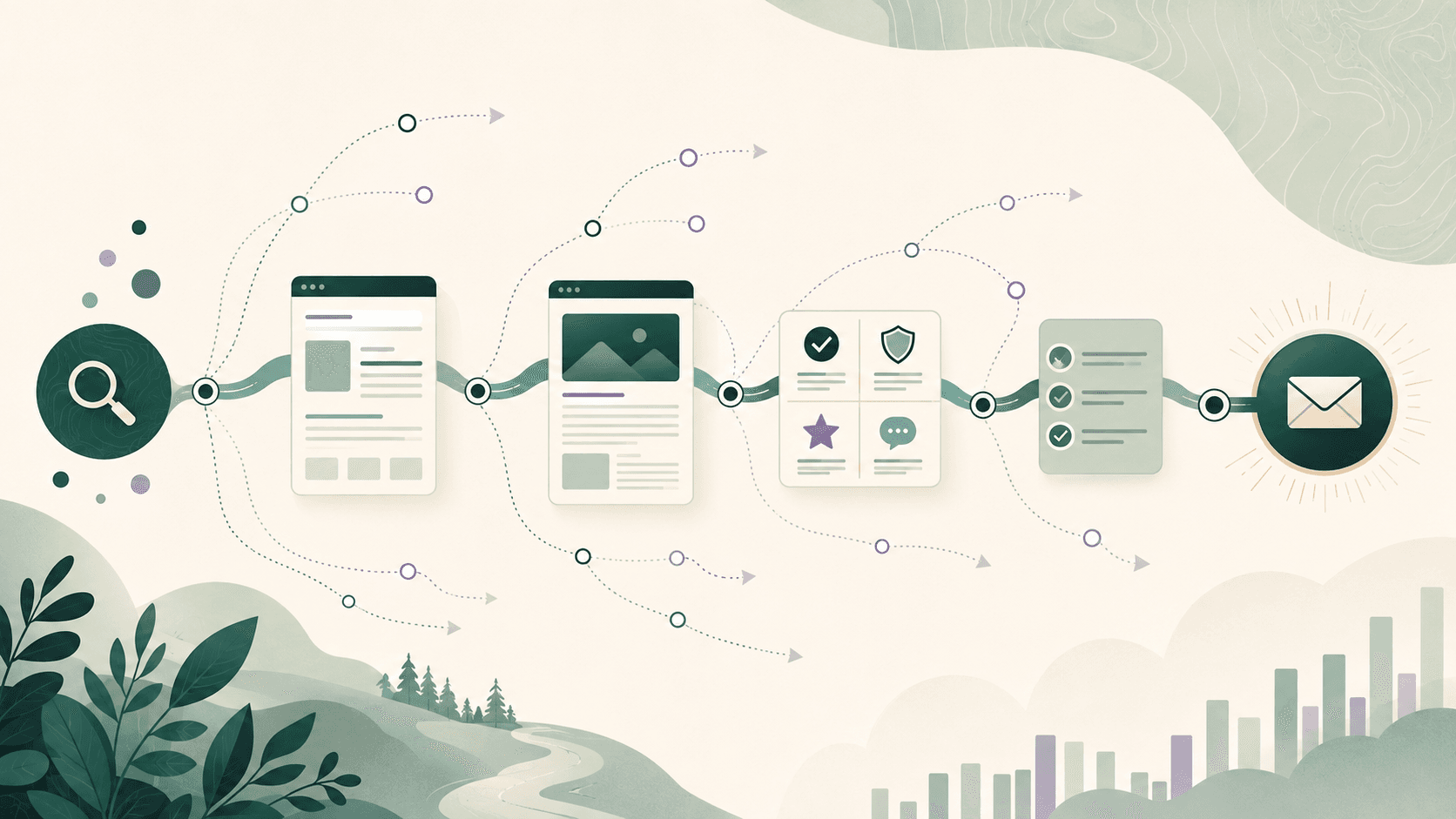
Define a small event dictionary: article view, meaningful next-page visit, approved form start, completed request, qualified lead, and accepted opportunity. For each event record the trigger, data source, consent dependency, owner, retention rule, and known failure modes. Test events on production without submitting real lead or booking forms; use approved non-conversion diagnostics or a dedicated test environment.
Google Analytics describes events as measured user interactions. Its attribution documentation explains that models assign credit using defined rules or data-driven methods. Search Console reports search performance rather than downstream CRM outcomes. These products therefore do not create a single complete causal record merely because their date ranges overlap.
Minimum useful dashboard
At page level, show eligible organic sessions or users according to the analytics setup, observed next actions, completed conversions, and data-quality notes. At content-family level, show trends without ranking individual pages solely by last-click conversions. An explanatory article can support a later branded return or sales conversation that the chosen model assigns elsewhere.
Audit joins between analytics and CRM carefully. Confirm timestamp time zones, campaign parameters, duplicate submissions, internal traffic rules, and lifecycle definitions. Keep “unknown” as a valid category instead of forcing unattributed records into organic.
Operating boundaries
BusinessGrowthAssistant can maintain the event dictionary, run non-destructive checks, and flag discrepancies. Analytics owners approve tracking changes; privacy and legal owners approve consent and retention behavior; revenue owners define qualified outcomes. Content editors should receive decision-ready summaries rather than personal-level browsing histories.
Limitations
Consent choices, blockers, cross-device behavior, offline conversations, cookie duration, deletion, and CRM gaps make observation incomplete. Attribution models distribute credit; they do not prove causation. Small samples amplify randomness, and conversion rate comparisons can be distorted by changing query mix or page purpose.
Evidence-led conclusion
Organic conversion observability is useful when the team can explain what was measured, what was joined, what remains unknown, and which decision follows. The honest output is a bounded operational signal, not a claim that one article caused the entire customer journey.
Sources
- Google Analytics Help, About events: https://support.google.com/analytics/answer/9322688
- Google Analytics Help, Attribution models: https://support.google.com/analytics/answer/10596866
- Google Search Console Help, Performance report: https://support.google.com/webmasters/answer/7576553