Published September 3, 2026.
Research question
What can a small marketing team observe between an organic landing page and a qualified inquiry without claiming certainty that its analytics cannot support?
Why the path is harder than a conversion count
An inquiry can follow several visits, devices, channels, and conversations. A person may first discover a research article, return through a brand search, read a service page, and submit a contact form later. A dashboard that assigns the outcome to one touch provides a reporting rule, not a complete account of the person's decision.
Google Analytics documentation explains that attribution models assign credit to touchpoints according to defined rules or data. Search Console's Performance report measures activity in Google Search, including clicks and impressions. These systems observe different parts of the path. Their records do not join perfectly, and privacy protections, consent choices, identity boundaries, and data processing can create gaps.
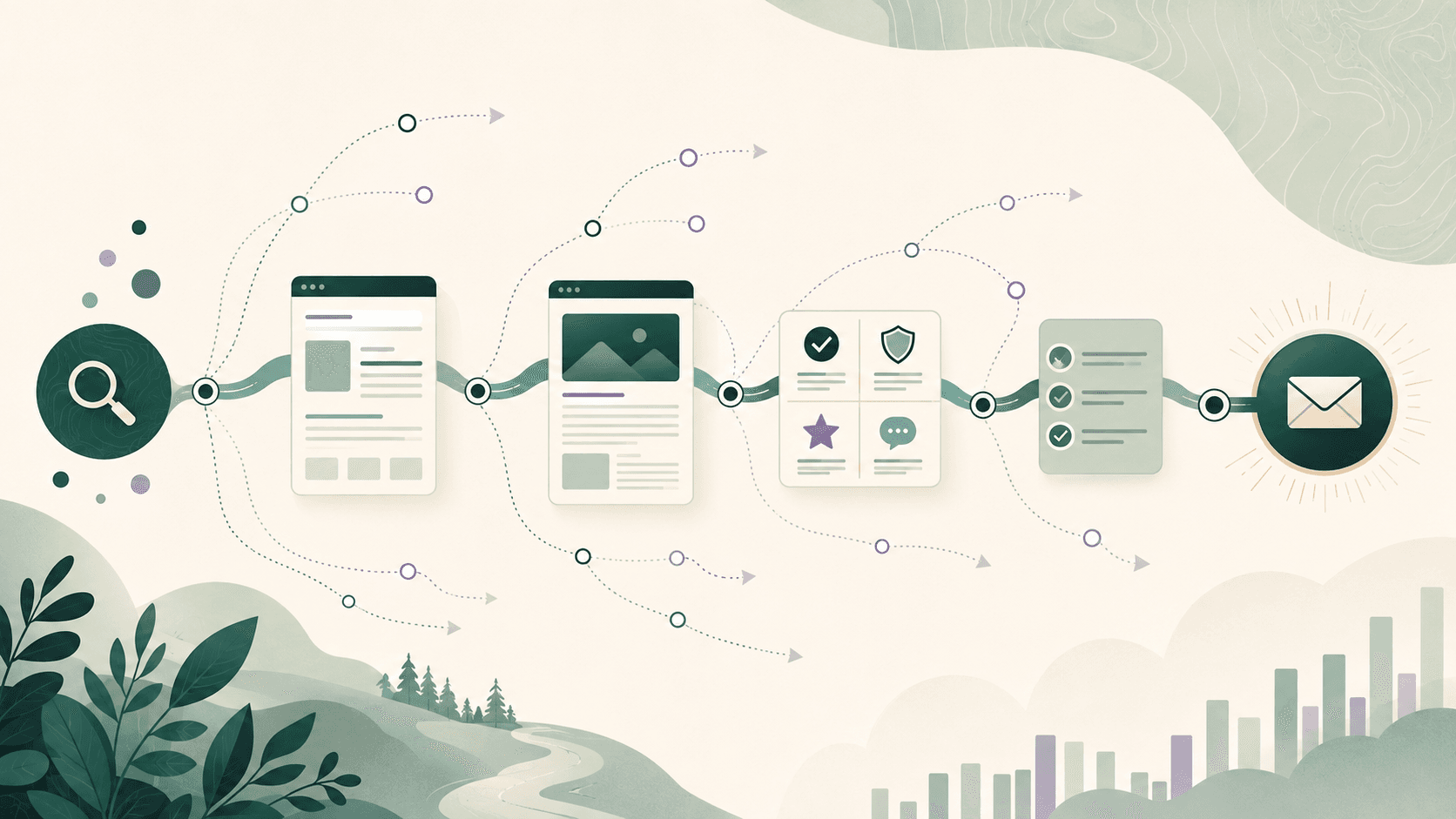
The framework below uses three evidence layers: search exposure, on-site progression, and inquiry qualification. The first two can often be measured with aggregated digital events. The third requires a business definition and an authorized owner. Connecting them creates a useful operating view, but it does not prove that one article caused one sale.
Evidence scope and definitions
Define a qualified inquiry before building a report. The definition might require a real contact method, a need within the company's services, and enough context for a responsible follow-up. Those are examples of fields a company could choose, not a recommended universal form. BusinessGrowthAssistant should use only information necessary for its actual response process.
Keep qualification separate from commercial outcome. A suitable inquiry can decide not to proceed, and an unsuitable inquiry can still submit a form. If the team labels every submission a lead, content performance becomes entangled with spam, job requests, vendor pitches, and out-of-scope needs.
Define the organic entry as a session or visit that the analytics system classifies according to its documented channel rules. Retain the original landing route. Search Console can add page-level search clicks and query patterns at an aggregate level, but individual Search Console queries should not be joined to individual people. The layers are compared as cohorts and trends.
On-site progression consists of a small set of meaningful events. Examples include viewing a service page after a research article, opening contact information, or reaching the contact form. An event should describe an observable action, not an assumed mental state. "Viewed service page" is observable. "Became convinced" is not.
Method: build the route cohort first
Start with a route inventory that classifies Research articles by the decision they support. A page about SEO publishing latency may help an operator evaluate process reliability, while a citation maintenance article supports evidence governance. Classification allows comparison among pages serving similar needs. Without it, a niche research page may look weak beside a broad explainer even when it attracts fewer but more relevant readers.
For each route cohort and time period, record Search Console impressions and clicks, analytics entrances, progression events, inquiry starts, completed inquiries, and qualified inquiries when the business owner permits that last aggregation. Keep the systems' numbers in separate columns. Do not force equality between clicks and sessions because collection conditions differ.
Use counts before rates. Then calculate clearly named rates with visible denominators, such as service-page progressions divided by observed organic entrances. A rate from three visits should never be presented with the confidence of a rate from thousands. Suppress or annotate sparse values according to the team's privacy and reporting rules.
Compare equal periods and inspect route-level values. A cohort total can hide one broken page. Conversely, a single inquiry can make a small route appear extraordinarily effective. Report both the aggregate and the distribution, then describe uncertainty in plain language.
Layer one: search exposure evidence
Search Console provides query, page, country, device, and date dimensions along with clicks, impressions, click-through rate, and average position. Use these fields to describe discoverability and the kinds of needs associated with a landing route. Do not call impressions "awareness" or clicks "interest" without qualification. They are recorded search events under Google's definitions.
Query clusters can indicate whether a route reaches people facing the decision it was designed to support. Privacy filtering means some query rows are absent. Page-level totals and query totals may therefore differ. Record that limitation instead of treating the unmatched portion as a data error.
Exposure evidence helps distinguish a discovery problem from an on-site progression problem. If an aligned route has few impressions, improving its contact call to action is unlikely to address the first constraint. If it receives appropriate search traffic but no readers reach the relevant service information, page fit and navigation deserve review.
Layer two: on-site progression evidence
Choose events that correspond to real transitions in the site architecture. The recommended-events documentation for Google Analytics provides naming guidance for common activities, but a small business still needs a measurement plan suited to its own pages. Event names should remain stable, documented, and free of sensitive text.
Track the source route and destination class rather than every possible click label. Useful classes might include related research, service explanation, about or trust information, and contact. This structure shows whether readers find an appropriate next step without collecting the content of form fields in analytics.
Validate event firing in a non-production or consent-respecting test flow when authorized. The current research task does not require submitting a form. In routine operations, a team can inspect implementation and event configuration without creating fake inquiries that pollute customer records.
Progression is not always the goal. A research article can answer a question completely, earn a citation, or help an existing customer without producing a service-page visit. Interpret the path according to the page's stated job. Forcing every Research route into a direct-response funnel would misread the library.
Layer three: qualification evidence
Qualification belongs in the customer or inquiry system, not in a web analytics guess. A designated owner reviews the submission against the agreed service and response boundaries. The reporting layer should receive only the minimum status needed for aggregate analysis, using a non-sensitive identifier where lawful and configured.
W3C privacy principles describe data minimization as processing only data that is necessary and proportionate. For this framework, that means a content report usually needs a route cohort, date bucket, and qualification status, not the person's message, name, email address, or browsing history.
Keep a visible count of unclassified inquiries. Excluding them silently inflates confidence, while treating them as unqualified can punish a route for an operational delay. Aging rules can show how much of a recent cohort remains unresolved.
Attribution language the evidence can support
The report can say that qualified inquiries were observed in journeys with an organic entry to a named route cohort, provided the tracking and join rules truly establish that relationship. It can say that a route cohort had a higher observed progression rate in one period. It can describe the attribution model used by the analytics platform.
It should not say that an article generated a precise amount of revenue unless the business has an appropriate outcome model and accepts its assumptions. It should not claim that a query belonged to a named person. It should not convert correlation into a causal statement.
When presenting comparisons, include the model, lookback rules, consent scope, excluded records, and unresolved count. This is not defensive paperwork. Those details explain what the number means and prevent different teams from comparing incompatible reports.
Operating decisions and boundaries
A content operator can use the evidence to propose a better internal link, clarify a service connection, repair a broken event, or investigate an off-intent query cluster. The owner decides qualification rules and any change to the customer journey. Privacy, legal, and analytics specialists should review changes that expand data collection or identity resolution.
Do not redesign a page around a handful of attributed outcomes. Check whether the page remains accurate and useful for its intended reader. Organic research content should support a real decision before it supports a dashboard metric.
Limitations
Consent choices, blockers, cross-device behavior, retention settings, channel definitions, offline conversations, and data thresholds can all hide parts of the path. Search Console and analytics process data differently. Attribution models distribute credit according to assumptions and cannot reconstruct every influence.
Small samples produce unstable rates, and qualification itself contains judgment. Route cohorts may mix readers with different needs. The framework does not establish causal lift, customer lifetime value, or ranking impact. It offers an observable operating chain with explicit gaps.
Evidence-led conclusion
A small team can connect organic discovery to qualified inquiry evidence by keeping search exposure, on-site progression, and business qualification as separate layers. The result is strongest when counts retain their denominators, qualification has a named owner, and privacy limits are designed into the report. This approach gives BusinessGrowthAssistant a practical way to improve content paths without pretending that a multi-touch decision has one certain cause.
Sources
- Google Analytics, About attribution and attribution models
- Google Search Console, Performance report
- W3C, Data minimization in privacy principles
- Google Analytics, Recommended events
Sources
- Google Analytics, About attribution and attribution models: https://support.google.com/analytics/answer/10596866
- Google Search Console, Performance report: https://support.google.com/webmasters/answer/7576553
- W3C, Data minimization in privacy principles: https://www.w3.org/TR/privacy-principles/#data-minimization
- Google Analytics, Recommended events: https://support.google.com/analytics/answer/9267735