Published September 6, 2026.
Research question
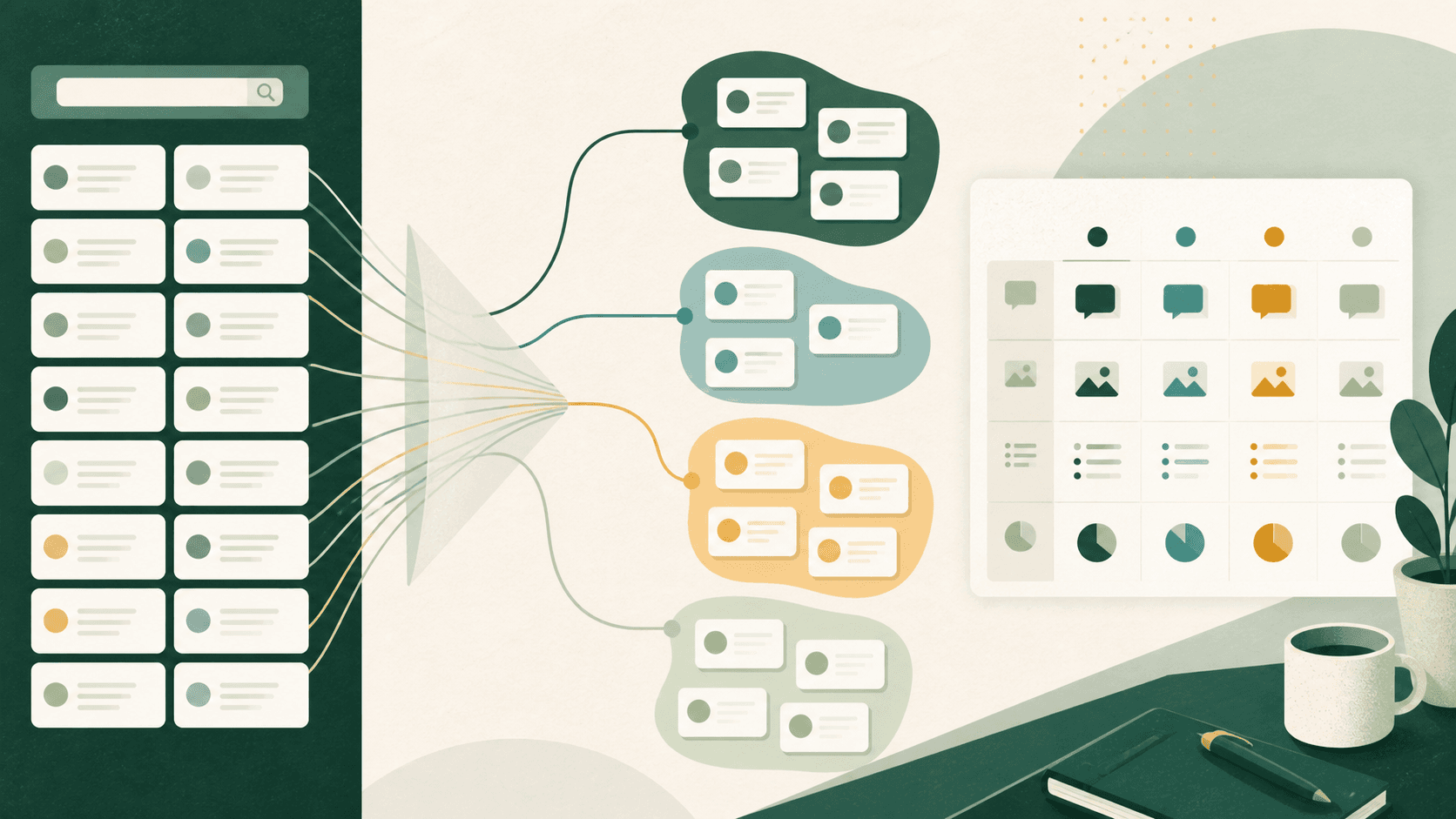
When do groups of similar queries justify an article change? Query exports create the appearance of precision, yet closely worded phrases can represent different tasks, and different phrases can represent the same task. This method treats clustering as a diagnosis aid rather than an automatic content generator.
Evidence scope and method
Start with one verified page and a defined reporting window. Export query, click, impression, position, device, and country dimensions where available and appropriate. Normalize only obvious formatting differences. Then group phrases manually by the answer a reader appears to need: definition, procedure, comparison, troubleshooting, or provider selection.
Google's Performance report documentation explains its metrics and notes that some query data is withheld for privacy. Google's people-first guidance supports answering the audience's actual needs rather than producing search-engine-first pages. Google Trends uses normalized, sampled interest rather than absolute demand. These boundaries matter: none of the tools reveals a person's private motive or guarantees a topic's commercial value.
Diagnosis choices
Compare each cluster with the current page. If the answer exists but the title and introduction obscure it, a snippet or opening revision may be enough. If the page answers a nearby question but repeatedly misses a material follow-up, add a bounded section. If the cluster serves a different decision stage and can sustain a distinct answer, create a separate brief. If volume is tiny, unstable, or driven by an ambiguous term, keep it in observation.
Use page-level context. A query phrase on a page ranking in several regions can shift because of geography, seasonality, device mix, or result features. Avoid treating average position as a single rank. Preserve the date range and filters so another reviewer can reproduce the view.
Application to daily article operations
BusinessGrowthAssistant can maintain a question ledger with the cluster, evidence window, current answer, proposed intervention, and reviewer. The owner chooses priority and decides whether a separate page fits the site's positioning. The workflow should favor improving an existing useful page before creating a near-duplicate solely because a phrase appeared in an export.
Limitations
Search Console is not a complete census of all queries and its aggregates can obscure individual paths. Manual clustering involves judgment. Trends data is normalized and sampled, while low-volume sites may not have enough observations for stable comparison. This method does not prove causality, predict rankings, or replace interviews and customer research.
Evidence-led conclusion
Query clusters are strongest when they produce a falsifiable editorial hypothesis: what question is underserved, where the current page fails, and what smallest change could improve the answer. They are weakest when converted directly into titles without inspecting the page or acknowledging missing data.
Sources
- Google Search Console Help, Performance report: https://support.google.com/webmasters/answer/7576553
- Google Search Central, Creating helpful, reliable, people-first content: https://developers.google.com/search/docs/fundamentals/creating-helpful-content
- Google Trends Help, Compare Trends search terms: https://support.google.com/trends/answer/4359550