
Published September 3, 2026.
Research question
How should a small business measure the time required to publish SEO content when approval, public availability, sitemap exposure, crawling, and search reporting happen at different moments?
One duration hides several systems
A team may say that an article took three days to publish, yet that number can describe very different delays. The brief may have waited for an owner. The page may have been committed but not released. The route may have gone live while its sitemap remained stale. Google may have crawled it later, and performance data may have appeared after that. Combining these events into one duration makes the routine hard to improve.
Google states that requesting a crawl does not guarantee immediate inclusion in search results and that crawling can take from days to weeks. Google also describes sitemaps as hints rather than guarantees. Those are documented facts. Our analysis is that a content operation should not use indexing time as if it were a direct measure of writer or publisher performance.
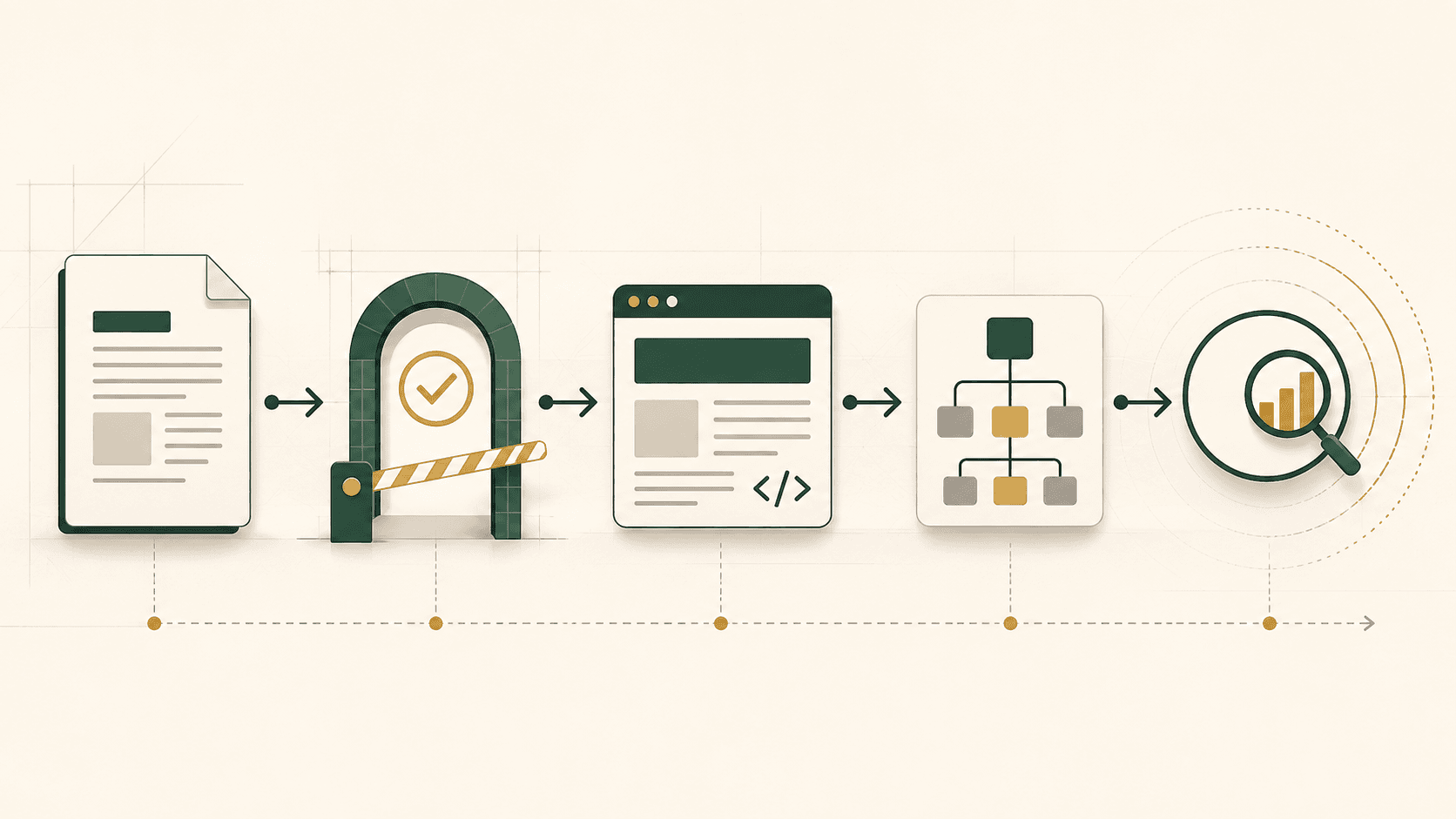
The proposed framework records five timestamps: ready for approval, approved for release, publicly available, discoverable through the site's intended surfaces, and externally observed. Each timestamp has its own evidence and owner. The purpose is not to make every interval shorter. It is to show where elapsed time occurs and which parts the team can control.
Evidence scope and event definitions
"Ready for approval" means the draft has passed the team's stated editorial checks and has a stable route proposal, sources, metadata, and required assets. It does not mean the article is correct simply because a status field changed. The evidence can be a revision identifier plus a completed review record.
"Approved for release" is the owner's explicit authorization when the workflow requires one. Some routine articles may use standing rules rather than individual approval. In that case, document the rule and the validation event that satisfied it. Do not invent a human approval where none occurred.
"Publicly available" is the first verified response from the canonical production URL that contains the intended article identity. A successful build or source commit does not prove this event. The check should record the route, response status, observation time, title, visible publication date, structured date, and canonical target.
"Discoverable" means the page appears in the required Research index and the appropriate sitemap output, and internal links promised by the release are present. This is a property of the site's output. It is not the same as being crawled or indexed by a search engine.
"Externally observed" is the first evidence available through tools such as URL Inspection or Search Console that Google knows about the page. Access and data delay vary. This timestamp should remain blank when evidence is unavailable rather than being estimated from a search query.
Measurement method
Create one record per route. Store timestamps in a consistent time zone, preferably UTC, while keeping the visible publication date as its own field. A date is not a timestamp. An article dated September 3 can be published at different moments during that day, and backdating a public page does not change when it became reachable.
For each transition, attach the smallest evidence that proves it. Revision identifiers prove source state. Build logs prove compilation. An HTTP capture proves route availability at the observation time. Rendered HTML proves visible and machine-readable identity. Sitemap XML and index HTML prove discovery surfaces. URL Inspection provides a different class of external evidence.
Calculate intervals only when both boundary events exist. Approval latency is the time from ready to approved. Release latency runs from approval to public availability. Discovery-surface latency runs from public availability to index and sitemap membership. External observation latency begins only after the page is publicly discoverable. A missing end event is an open interval, not a zero.
Report medians and raw route values for a batch. Averages can be dominated by one stuck item, while a median alone can conceal that item. With a five-article batch, the individual durations are often more informative than a summary statistic. Avoid percentiles on tiny samples because they imply more precision than the dataset supports.
What the intervals mean operationally
Long approval latency may indicate unclear decision rights, an incomplete brief, or an owner capacity constraint. It does not demonstrate weak writing. Review the reasons attached to returned drafts. If most waits concern service claims, the team may need a defined source of truth for those claims rather than a faster reminder system.
Long release latency points toward build, integration, scheduling, or production controls. Separate failed attempts from intentional scheduling. A route intended for a future date is not late before that date. A route approved for immediate publication that remains absent from production is a release fault.
Long discovery-surface latency is under direct site control. If the loader automatically includes new Research files in the index and sitemap, both surfaces should update with the same release. A mismatch suggests caching, routing, or content classification trouble. This interval deserves a strict release threshold because the publisher owns the relevant system.
External observation latency is different. Google explains that sitemap submission and recrawl requests do not guarantee a timetable. Teams can make a page accessible, internally linked, canonical, and included in a sitemap, but they cannot promise when a crawler will visit it or when reporting will update. Treat this interval as an observation for planning, not a service-level commitment.
A daily routine built around controllable evidence
At the start of the day, review open records by current state rather than by article count alone. A draft awaiting source verification needs editorial work. An approved article awaiting production needs release attention. A live route missing from the sitemap needs technical correction. This state view prevents the team from creating more drafts while completed work is stranded downstream.
After release, run identity checks from the public host. Confirm HTTP 200, the expected title, the literal visible date, datePublished, a self-canonical URL, Research index membership, and sitemap membership. These checks prove the controllable boundary. They should not submit forms, manufacture engagement, or claim search indexing.
Use weekly review to inspect recurring waits. A single slow approval may reflect a necessary legal or factual check. Repeated delays at the same boundary indicate a process issue. Propose a change, such as improving the brief or assigning a release owner, then compare later records. The timestamps support that discussion without turning the publishing routine into surveillance of individual effort.
Facts, interpretation, and governance
Recorded timestamps, revision identifiers, HTTP results, and rendered fields are facts within the measurement system. Labels such as "approval bottleneck" or "slow discovery" are interpretations. Keep them separate so the team can correct a clock or redefine an event without rewriting history.
An owner should set which transitions require approval and which validations block release. A content operator should not bypass an approval gate merely to improve a latency metric. Likewise, a search observation should never be fabricated to close a record. An honest blank is better evidence than an inferred success.
Limitations
Clock accuracy, cache location, deployment architecture, and observation frequency affect recorded times. The first successful check establishes an upper bound on when an event happened, not necessarily the exact instant. Search Console and URL Inspection data may lag, and access can be restricted.
The framework does not measure article quality, reader value, rankings, or revenue. Faster publication can magnify errors when validation is weak. Comparisons across teams require shared definitions. Even within one team, a major research brief should not be benchmarked against a short routine update without context.
Evidence-led conclusion
Publishing latency becomes useful when the team stops treating publication and search discovery as one event. Five timestamps expose where work waits, which evidence proves each transition, and which delays the publisher can actually control. For BusinessGrowthAssistant's daily article and SEO routine, the most defensible completion boundary is a correct public route with verified discovery surfaces. Later crawl and reporting signals remain valuable observations, but they are not promises the team can make.
Sources
- Google Search Central, Ask Google to recrawl your URLs
- Google Search Central, Build and submit a sitemap
- Sitemaps.org, XML sitemap protocol
- Google Search Central, URL Inspection tool
Sources
- Google Search Central, Ask Google to recrawl your URLs: https://developers.google.com/search/docs/crawling-indexing/ask-google-to-recrawl
- Google Search Central, Build and submit a sitemap: https://developers.google.com/search/docs/crawling-indexing/sitemaps/build-sitemap
- Sitemaps.org, XML sitemap protocol: https://www.sitemaps.org/protocol.html
- Google Search Central, URL Inspection tool: https://support.google.com/webmasters/answer/9012289