Published September 6, 2026.
Research question
How should a small content team measure the delay between an approved brief and a discoverable production article? A single “publishing time” hides writing, review, deployment, and search discovery inside one number. This framework separates those intervals so the team can improve the part it controls.
Scope and method
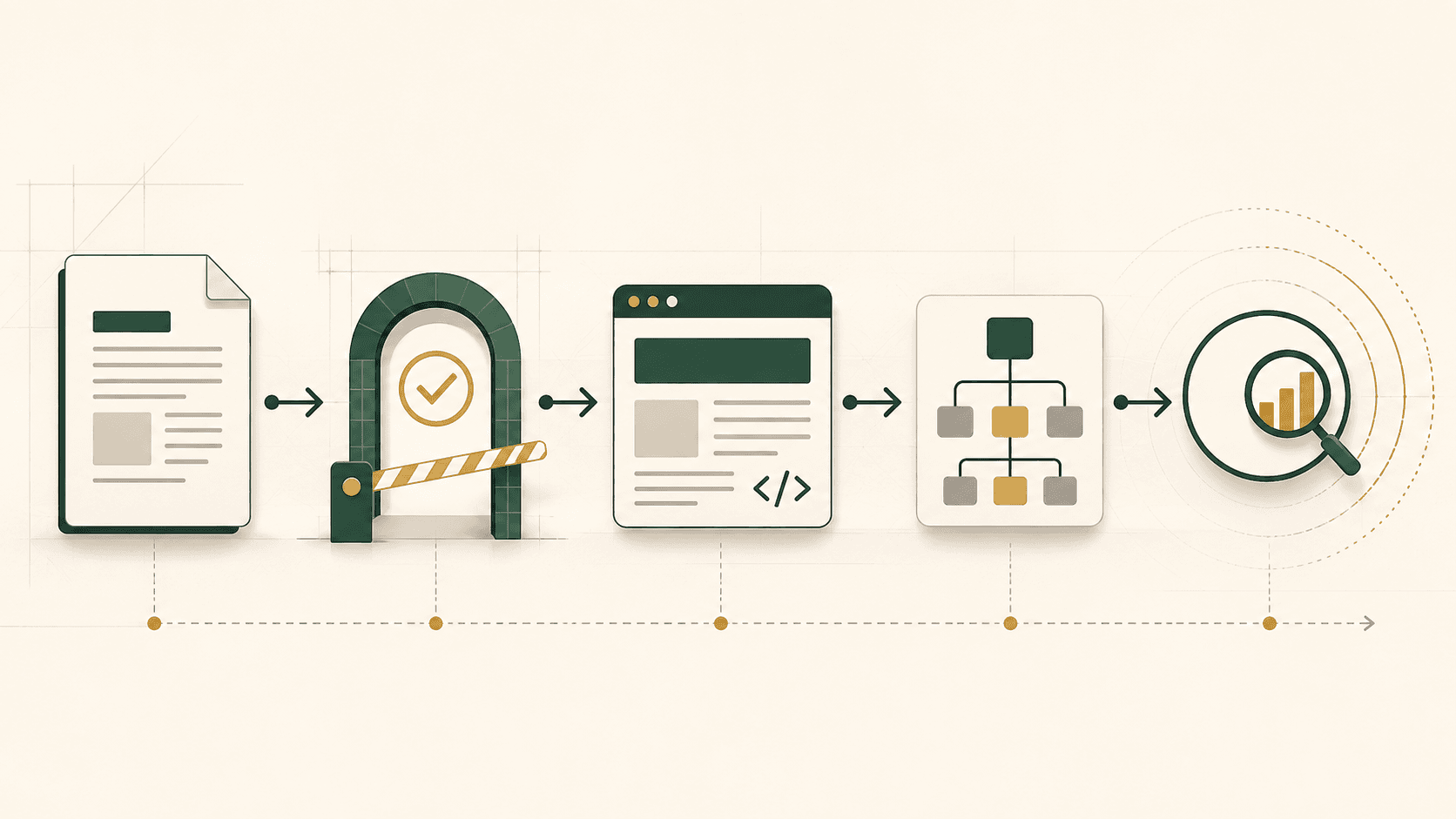
Create timestamps for brief ready, draft ready, editorial approval, merge, deployment success, first successful production request, sitemap membership, and first observed index status. Calculate elapsed time between adjacent events and assign the owner of each handoff. Use medians and visible distributions when the batch is large enough; do not let one unusually slow item define the routine.
Google explains that requesting a crawl does not guarantee immediate inclusion and that crawling can take time. Its sitemap guidance describes sitemaps as a discovery aid rather than a guarantee. The URL Inspection documentation provides a way to inspect known status, subject to the tool's own timing and data boundaries. Together, these sources support separating production availability from search discovery.
What the intervals reveal
A long brief-to-draft interval points to capacity, unclear scope, or missing evidence. A long approval interval points to reviewer availability or an oversized change. A long merge-to-live interval is a release-system issue. A live page absent from the intended sitemap is a publishing defect. A live, sitemap-listed page not yet observed as indexed may simply be awaiting crawling; it should not be mislabeled as a failed deployment.
Track rework separately. An article that reaches approval quickly but returns twice for unsupported claims is not an efficient success. Likewise, releasing quickly with a wrong canonical creates negative latency: the page is technically live while the intended identity is not.
Operating application
For BusinessGrowthAssistant, the daily record should make publication gates explicit: correct family, visible date, structured date, self-canonical, index membership, sitemap membership, valid image, and clean layout. The content operator can collect timestamps and evidence. The repository owner controls merge, while the deployment owner controls the production application. Search engines control later crawl and index behavior.
Limitations
Index-status observations may lag and can vary by tool, property, and URL. Small samples make percentiles unstable. Teams may also record timestamps inconsistently or work across time zones. This method does not estimate ranking impact, traffic value, or the “ideal” article cadence. It diagnoses elapsed handoffs; it does not prove that faster publishing produces better search performance.
Evidence-led conclusion
Small teams should treat publishing latency as a chain of distinct, owned intervals. Production availability and search discovery are separate outcomes. The most useful measure is the one that identifies a controllable wait, preserves its evidence, and leads to a bounded process change.
Sources
- Google Search Central, Ask Google to recrawl your URLs: https://developers.google.com/search/docs/crawling-indexing/ask-google-to-recrawl
- Google Search Central, Sitemaps overview: https://developers.google.com/search/docs/crawling-indexing/sitemaps/overview
- Google Search Console Help, URL Inspection tool: https://support.google.com/webmasters/answer/9012289