Published September 3, 2026.
Research question
How can a small content team decide which citations to recheck first when its research library grows faster than its review capacity?
Link checking is necessary but incomplete
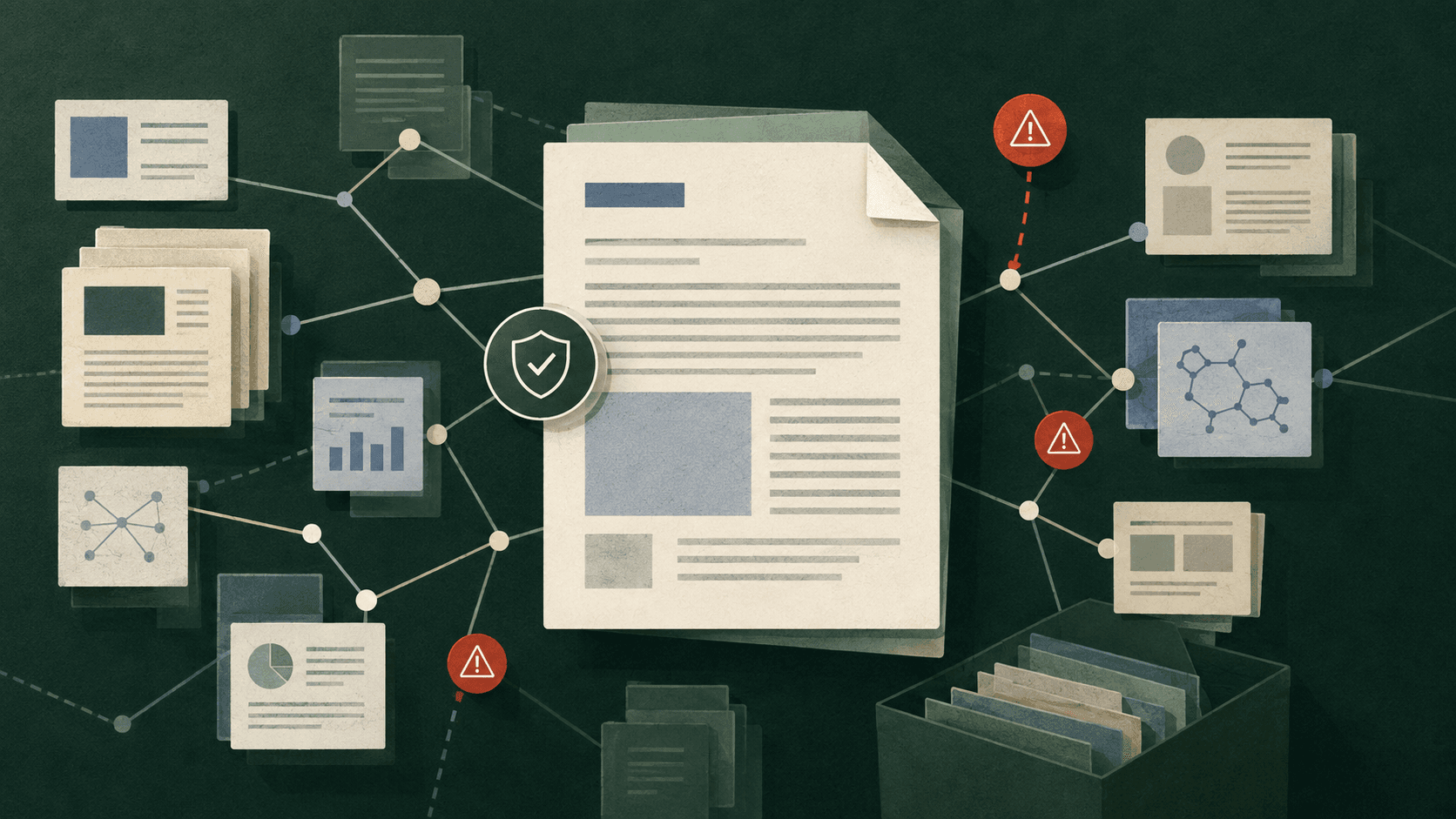
A citation can fail in several ways. The URL may stop resolving. The page may still load while the relevant statement changes. A secondary summary may remain online after the primary standard has been revised. A source can support a number but not the conclusion built around it. Treating every successful HTTP response as a healthy citation misses most of these risks.
NIST's information quality standards discuss quality in terms that include objectivity, utility, and integrity. Google's people-first content guidance asks whether material demonstrates clear sourcing and trust. WCAG requires that link purpose be understandable in context. These sources do not prescribe the scoring model below. They establish that source quality, usefulness, integrity, and clear link context are legitimate concerns. The model is our operational synthesis for a small Research library.
The proposed review unit is a claim-source pair. One article may cite a source several times for different claims, and one claim may depend on multiple sources. Reviewing at article level alone hides that structure. The model ranks each pair using four factors: claim volatility, source authority, dependency depth, and consequence if wrong.
Method and evidence scope
Build a citation register from the published Research files. For each substantive external claim, record the exact claim or a stable excerpt, its article route, section, source URL, source title, publisher, access date, and whether the source is primary or secondary. Do not collect personal information or bypass access controls. If a source is unavailable to the reviewer, mark access as limited.
The register should distinguish a source listed for general reading from a source that supports a specific factual statement. A bibliography can look substantial while leaving the central claim untraceable. The reviewer should be able to move from the claim to the evidence without guessing which reference was intended.
Score each factor on a small documented scale. A two- or three-level scale is usually enough. Numerical precision is not the goal. The score orders review work and records why one citation was checked before another.
Claim volatility asks how quickly the subject can change. A stable protocol definition is usually less volatile than a software interface, policy, product specification, market estimate, or current performance benchmark. Publication age can inform this factor, but age is not the factor itself. An old source can remain correct, and a new source can become obsolete quickly.
Source authority asks how close the evidence is to the subject. Official documentation, standards bodies, regulators, and original research generally provide more direct evidence than an unattributed summary. Authority depends on the claim. A vendor is authoritative about its own documented feature but not automatically about the feature's business impact.
Dependency depth counts how much of the article rests on the claim. A supporting definition has lower structural dependency than the statistic used in the title, opening, and conclusion. Repeated use increases maintenance risk because one source change can affect several passages or routes.
Consequence asks what happens if readers act on an incorrect claim. Advice touching legal duties, security, accessibility, health, finance, or irreversible customer communication deserves careful review and appropriate expert boundaries. BusinessGrowthAssistant should not convert source-backed operational research into professional advice outside its role.
Turning factors into a review queue
Use a transparent rule rather than a mysterious composite score. One option is to place any high-consequence claim in the first tier, then add high-volatility claims with weak or indirect sources, followed by deeply repeated claims. Stable definitions from primary sources can sit in a lower-frequency review tier.
The queue should also respond to events. A broken link, source revision notice, product release, regulatory update, reader correction, or internal service change can trigger an immediate check. Event-driven review prevents a calendar from delaying a known risk.
Crossref's work to include Retraction Watch data illustrates why source status can change after publication. Retraction evidence is particularly relevant to scholarly sources, but the broader operating lesson is not that every source will be retracted. It is that publication is not the end of evidence maintenance. A research library needs a way to record later source events.
Run the first review on the highest tier. Open the source and verify that the cited material remains present, comes from the expected publisher, and supports the current wording. Check whether a newer version supersedes it. Capture the review date and outcome, but do not copy large copyrighted passages into the register.
Possible outcomes are confirmed, wording narrowed, source replaced, claim removed, expert review required, or access unresolved. Replacing a source should not be a cosmetic swap. The new evidence must support the actual claim. If it supports only a weaker statement, revise the article accordingly.
Separating automated and editorial checks
Automation can extract URLs, identify duplicates, test response status, follow redirects within safe limits, compare known titles, and flag sources not reviewed by a due date. Those checks are useful for a daily routine because they reduce clerical work.
Automation cannot reliably decide whether a passage supports an interpretation in context. A page returning 200 may be a generic home page after a redirect. A title match does not prove that the cited section remains. A language model summary is not a substitute for reading the source. Editorial verification remains necessary for high-risk claims.
The split should be explicit. Machine findings create review candidates. A named reviewer decides whether the evidence still supports the claim. This prevents a green link-check report from becoming an unsupported declaration that the library is accurate.
Citation language and reader access
Link text should identify the source and topic rather than using repeated phrases such as "click here." WCAG's link-purpose guidance is written for accessibility, and it also helps research readers understand where a citation leads. Clear source titles make later maintenance easier because reviewers can recognize an unexpected redirect.
When a source is behind a login or paywall, disclose that access condition where it matters. Prefer public primary sources when they provide equivalent evidence, but do not misrepresent a weaker public source as equivalent merely for convenience. A citation should help a reader inspect the basis of a claim.
Keep citations close enough to the supported passage to avoid ambiguity. A long sources list at the end can coexist with inline links, but the article still needs a clear mapping. If the site's schema stores citations separately, maintain the same source identities in visible content and structured output.
Governance and decision boundaries
The content operator owns the register, routine checks, and proposed corrections. A service or company owner approves changes to positioning and capability claims. A qualified professional reviews material that crosses legal, financial, security, accessibility, or other specialist boundaries. Removing a claim is often safer than improvising a replacement outside the team's knowledge.
The queue should not reward citation volume. Three direct, relevant primary sources can be stronger than a long list of repeated summaries. Nor should the model be used to make a ranking claim. Search performance is outside its measured scope. The goal is evidence integrity for readers and operators.
Limitations
Factor ratings contain judgment. Two reviewers may assess volatility or consequence differently. The model needs examples and periodic calibration, yet calibration cannot remove all disagreement. Some sources update without a visible version history, and archived copies may not be available or appropriate to rely on.
The method also adds maintenance work. A small team should begin with central claims and recent high-risk articles instead of attempting a perfect inventory in one pass. No review proves that a source will remain correct tomorrow. The register documents the best available check at a specific time.
Evidence-led conclusion
Citation maintenance is more than finding dead links. A claim-level queue based on volatility, authority, dependency, and consequence directs limited review capacity toward failures that would matter most. Automated checks can find candidates, while editorial review decides whether the evidence still supports the words on the page. That division gives a growing Research library a practical maintenance routine without pretending that every citation carries equal risk.
Sources
- W3C, Web Content Accessibility Guidelines 2.2
- NIST, Information Quality Standards
- Google Search Central, Creating helpful, reliable, people-first content
- Crossref, Retraction Watch data in Crossref
Sources
- W3C, Web Content Accessibility Guidelines 2.2: https://www.w3.org/TR/WCAG22/
- NIST, Information Quality Standards: https://www.nist.gov/director/information-quality-standards
- Google Search Central, Creating helpful, reliable, people-first content: https://developers.google.com/search/docs/fundamentals/creating-helpful-content
- Crossref, Retraction Watch data in Crossref: https://www.crossref.org/blog/retraction-watch-data-now-in-crossref/